The Future of Healthcare Staffing: 2025–2030 Predictions
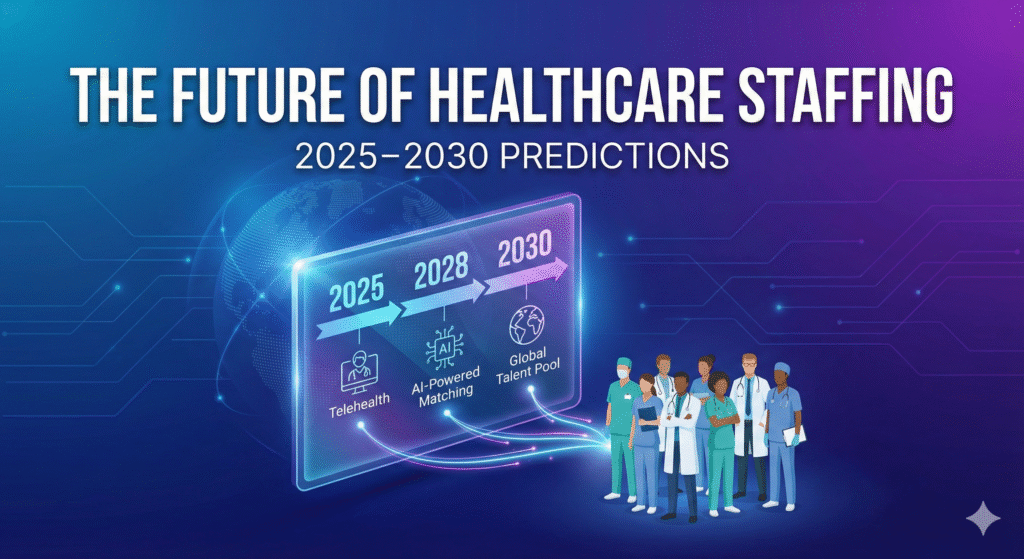
The Future of Healthcare Staffing: 2025–2030 Predictions
(Insights from the SIA Healthcare Staffing Summit)
The 2025 SIA Healthcare Staffing Summit made one thing very clear: the industry isn’t collapsing after the pandemic surge—it’s evolving into a leaner, more technology-driven, and more segmented market.
Recent data shared at and around the Summit show:
SIA projects U.S. healthcare staffing revenue at about $39.4 billion in 2025, reflecting a normalization from pandemic highs but still a large, durable market.
Other market analyses expect steady growth through 2030, with U.S. healthcare staffing in the tens of billions and global healthcare staffing markets growing at ~3–8% CAGR through 2032, depending on segment and methodology.
A SIA-based summary notes the broader U.S. healthcare staffing industry could reach around $64.5 billion in 2025, with strong contributions from travel, per-diem, and allied health.
So what does that mean for 2025–2030? Let’s break it down.
1. From Crisis Boom to Stable, Multi-Segment Growth
During COVID, travel nursing dominated the story. Now, SIA data presented via multiple partners shows a correction and re-balancing:
Travel nurse revenue spiked above $44 billion in 2022, then fell and is projected around $14.2 billion in 2025 as hospitals pull back from crisis-level bill rates and contract lengths.
At the same time, per diem nursing, allied health, and locum tenens are growing or holding strong, rather than collapsing.
Prediction:
Between 2025 and 2030, expect moderate but steady growth across a portfolio of segments instead of one “super-segment” like travel RNs. Agencies that rely on a single revenue stream will feel more risk; those that diversify into locums, allied, per diem, advanced practice, and non-clinical support roles will be more resilient.
What this means for you:
Build dedicated business lines (or at least separate pipelines) for travel, per diem, allied, and locums.
Adjust sales messaging: talk to clients about total workforce strategy, not just “travel nurse coverage.”
2. Locum Tenens & Advanced Practice: The New Growth Engine
One of the loudest themes at the SIA Summit: locum tenens isn’t a stop-gap anymore—it’s core strategy.
Recent SIA-based figures shared around the Summit show:
Locum tenens + advanced practice revenue has more than doubled since 2019, from about $5.2B to a projected $9.6B in 2025, and is expected to keep growing (5% in 2025, 4% in 2026).
That’s roughly 24% of the total U.S. healthcare staffing market by 2025 and still climbing.
A large majority of facilities (around 80%) report using locum providers and expect that use to stay steady or increase.
Permanent physician recruitment, meanwhile, is getting slower—averaging close to 300 days for a permanent placement, according to Summit insights.
Prediction:
By 2030, locums and advanced practice (NPs, PAs, CRNAs) will be baked into hospital workforce planning—not just a last-minute fix.
Action tips for staffing pros:
If you’re not in locums or advanced practice yet, start building that capability (credentialing depth, malpractice knowledge, higher-touch account management).
Educate clients on long recruitment timelines and use locums as a planned bridge, not a panic purchase.
3. MSPs, VMS Platforms & AI Become Default Infrastructure
Another core message from the Summit and related SIA research: healthcare staffing is turning into a platform business.
Data shared via SIA and partners shows that:
Around 80% of travel nurse staffing revenue now flows through MSP or VMS programs, up from 72% in 2019, with MSPs capturing the bulk of that volume.
A 2025 survey of staffing executives cited in Summit recaps found over 90% expect to adopt platform-based solutions within five years, and healthcare staffing leads other verticals in platform adoption.
SIA’s Healthcare Staffing Summit keynote and follow-up reports highlight technology as one of the biggest trends impacting healthcare staffing, with a majority of executives planning to increase tech spend.
On the ground, about 57% of agencies use digital credentialing tools and 46% use AI-assisted matching or scheduling as of 2025.
Summit speakers emphasized AI as a “co-pilot,” not a recruiter replacement, especially for: sourcing, lead scoring, credential pre-checks and personalized outreach.
Prediction:
By 2030, if you’re a mid-to-large healthcare staffing firm, you’ll be expected to operate on integrated MSP/VMS + ATS + AI tooling as standard—not as a differentiator.
Action tips:
Prioritize tools that integrate (ATS + VMS + back office) instead of adding isolated point solutions.
Pilot AI for shortlisting, email sequences, and credentialing pre-screen, while keeping humans in charge of relationships and final decisions.
4. Burnout, Mobility & Regulation Reshape the Workforce
Physician and clinician burnout is still a central driver of staffing volatility.
Summit recaps note that while burnout metrics have improved slightly from peak, physician burnout remains historically high and is directly tied to shortages and reduced clinical hours.
A 2025 survey reported by Reuters found 55% of U.S. healthcare workers plan to change jobs by 2026, with many citing burnout, lack of appreciation, and limited career growth.
Regulators are also turning up the heat: the U.S. Federal Trade Commission has warned healthcare employers and staffing firms to review non-compete practices, signaling a push for greater worker mobility.
Prediction:
Between now and 2030, expect:
Higher clinician mobility (more job changes, more temp/PRN work).
Growing pressure for flexible schedules, career paths, and education benefits.
Stricter scrutiny of non-competes, pay transparency, and worker protections.
Action tips:
Build retention into your model: education support, loyalty bonuses, mental-health-friendly scheduling, and clear communication.
Make sure your contracts and policies are legally clean and worker-friendly—agencies that embrace fair mobility will attract more clinicians.
5. Data & Cash-Flow Discipline Separate Winners from the Pack
A big recurring theme in SIA Summit commentary: you can’t improvise your way through the next cycle.
Key data points:
SIA benchmarking shows healthcare staffing—and especially travel nurse firms—often face long days sales outstanding (DSO), with some segments waiting close to 80 days for payment, compared with a ~46.5-day median for staffing overall.
Separate research based on SIA data places average DSO around 49 days for healthcare staffing agencies in 2025, with over 40% of agencies relying on financing solutions to manage cash flow.
Summit recaps stress that the winning firms will be those that use integrated data (claims data, provider data, internal ops metrics, candidate interactions) to forecast needs, prioritize pipelines, and prove value to clients.
Prediction:
By 2030, data maturity and financial discipline will matter as much as sales hustle. Agencies with clean, integrated data and tight cash-flow management will scale; others will struggle to invest in tech, talent, and growth.
Action tips:
Track and actively manage DSO, gross margin by client, fill rates, time-to-submit, time-to-start, and clinician retention.
Use these metrics to coach recruiters, negotiate with clients, and decide which programs are actually profitable.
2025–2030 Action Plan for Healthcare Staffing Professionals
Here’s how to turn these predictions into concrete steps:
Diversify your book of business
Add or grow locum tenens, advanced practice, per diem, and allied health alongside travel nursing.
Specialize where it matters
Own a niche—ICU, OR, behavioral health, radiology, rural markets, or locums in key specialties.
Invest in integrated tech and AI
Prioritize ATS–VMS integration, digital credentialing, AI-assisted sourcing & matching, and automated back office.
Design a retention-first candidate experience
Faster credentialing, transparent pay packages, better communication, and more flexibility = less churn.
Treat data like a product
Clean it, integrate it, and use it for forecasting, client reporting, and recruiter performance management.
Protect margin with smart pricing and DSO discipline
Don’t just chase volume—focus on profitable contracts and clear expectations with clients about rates and payment terms.
If you build around these themes, you’re not just reacting to the future of healthcare staffing—you’re actively shaping your slice of it.